
Anti-perfume
Monocle Radio called Prem Rouge an anti-perfume. The word has followed us since.
It is not a perfume you cannot smell, and it is not a rejection of fragrance. I have loved perfume all my life. It is a fragrance built against the conventions of the industry that makes it: the composition, the packaging, and the way it is put together.
Prem Rouge is a layerable fragrance duo, 100% natural and alcohol-free. Each of the three works against a default.
The composition
Almost every perfume is 70 to 90 per cent alcohol. After my accident in 2022 the neurologist said no alcohol. Giving up drinking was easy, since I had never been much of a drinker. Perfume was the problem.
The obstacle is physical. Water and oil do not mix, which is why alcohol-free fragrance had mostly meant oils and roll-ons rather than a spray. What made ours possible was a French emulsion technology that disperses plant oils through water without a solvent.
Everything in it is plant-derived. No synthetics, which is the other default, and a harder one to work against than it sounds.
Why working without synthetics is difficult
Restricting a perfumer to plants removes most of the palette. The usual estimate is around 3,000 synthetic materials against roughly 1,000 naturals, and under the ISO definition of natural, only about 40 per cent of a working perfumer's palette qualifies.
Some effects go out of reach altogether rather than becoming harder. There is no botanical aquatic. The entire marine family in modern perfumery rests on a single molecule, Calone, discovered at Pfizer in 1966 during work on a tranquilliser. Nothing that grows smells like it.
What remains is less biddable. A natural rose oil carries more than 300 identified compounds. A synthetic rose accord is built from a handful. That gap is the reason to use naturals and also the difficulty of using them, because you cannot adjust one facet of a material carrying 300 without moving several others with it.
Naturals shift, too. They change with the harvest and the distillation, and they keep developing in the bottle. They are scarce in a way synthetics are not: around 7,000kg of tuberose flowers yield 1kg of absolute.
Synthetic perfumery also has fixatives, heavy engineered molecules that flatten the evaporation curve and anchor a fragrance to the skin for a working day. Naturals have no equivalent. The only way to slow a composition down is to balance the molecular weights so the heavier materials hold the lighter ones in place, and that balance is easy to break.
Removing the alcohol compounds all of it. Alcohol is not only the carrier. It is the solvent that binds a composition together, and the lift that gives a fragrance its opening. Take it out and each of those has to be solved another way, on a base of water, using the most difficult materials available.
The formulation was done in France, by Clémentine Humeau and Patty Canac. It took a year, which is about four times longer than I told people it would take.
The packaging
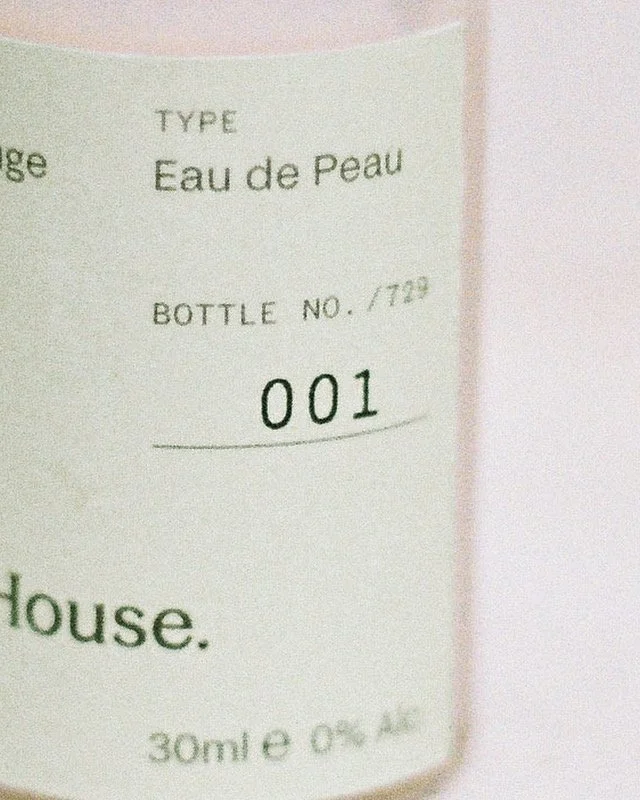
The bottles are plain glass with screw-on necks, so they can be refilled. The label carries the number, and it is applied by hand.
The way it is put together
This is the part nobody sees.
The fragrance supply chain is built for scale. Every supplier works to minimum order quantities, and those quantities assume you are not small. Making something in small numbers means going supplier to supplier asking each one for the least they will make.
The batch is 729 numbered sets. That number is not a marketing device. Each set is two bottles, and 729 is as many as I could label myself.
The brief started in the same contrary place. Most of the perfumers I spoke to took a technical view of the work. The one we chose was the first to ask what I wanted people to feel, and where I wanted them taken.
Two bottles, not one
The industry sells a signature. One scent, one identity, worn the same way daily.
Prem Rouge is two fragrances, sold only as a duo, composed together as halves of one system. One draws on Kashmir, the rose. One draws on Provence, the tuberose. Each is complete worn alone. Worn together they become something neither is on its own, and the balance is yours to set.
What it costs
There is no point listing the choices without the price of them.
You give up the opening. There is no bright burst on application, and if you are used to one, the first minutes feel like nothing is there. Give it ten.
You give up projection. The water base means the scent stays close to the skin rather than filling the air. If someone can smell it, they are near you. In a market that measures success by how far a scent travels, that is a deliberate loss.
You give up consistency of the industrial kind, and the ease of a single signature, which for some people is the whole pleasure of perfume.
And natural does not mean allergen-free. 16 of the EU's original 26 declarable fragrance allergens occur naturally in essential oils. We work this way for the quality of the scent, not as a safety claim.
Made in Britain. Formulated in France. Certified by The Vegan Society, and a Certified B Corporation™.
If you would like the base explained on its own, we wrote about that separately: What is alcohol-free perfume?
We write quietly, and not often. Subscribe if you would like to read along.