
How to test a fragrance at home
Most of us choose a perfume in a hurry. A crowded counter, a few seconds, half a dozen other scents already in the air, and something you might wear for years decided in a moment. At home you have the one thing the counter cannot give you: time.
Trying before deciding has always been how Prem Rouge works. Every set arrives with a sample alongside the sealed box, so you can sit with the scent for two weeks before opening it, and if it is not for you, the sealed set goes back for a full refund. Each sample holds a small cloth dipped in the perfume, the older way perfumers smelled a fragrance.
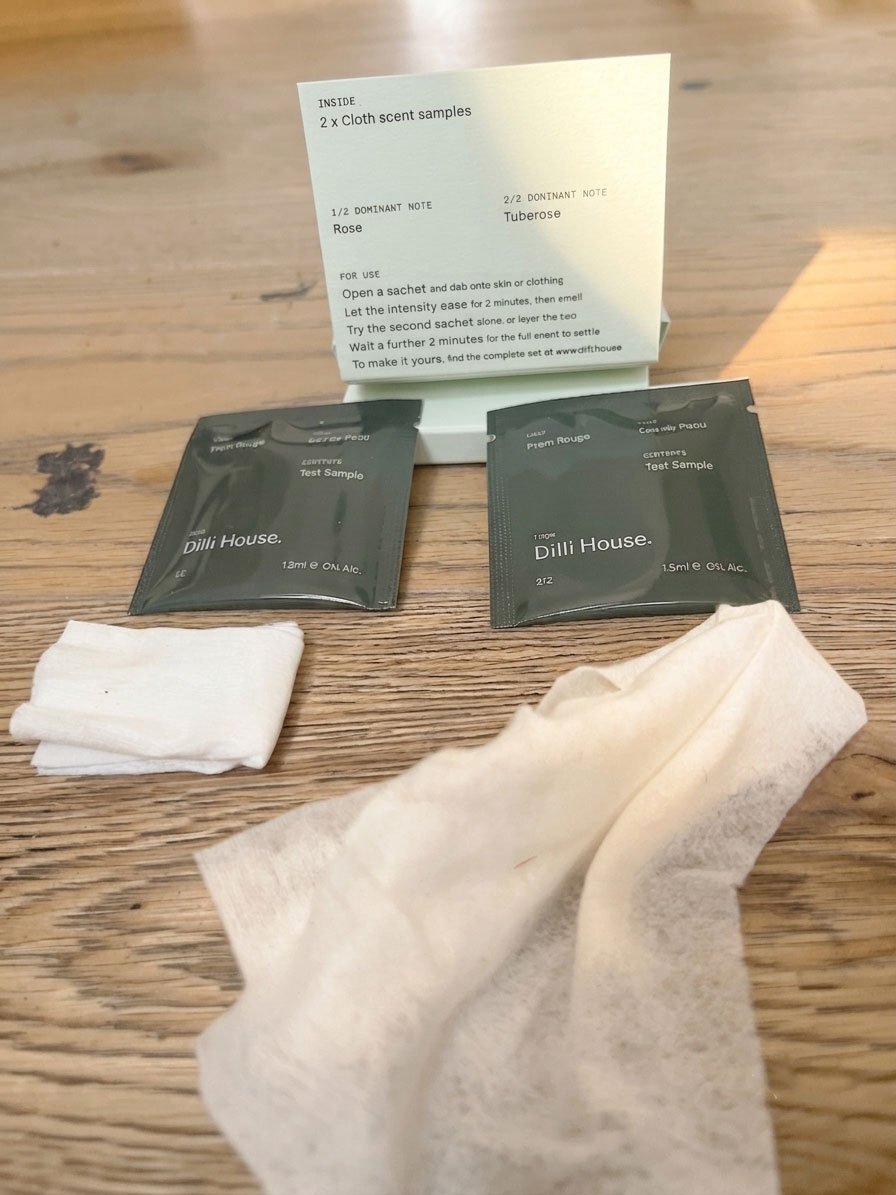
We suggest the cloth for a reason. Prem Rouge is alcohol-free, water-based, and made from natural materials. Water-based fragrance behaves differently to the alcohol-based kind, and the difference matters most on fabric. On cloth, a water-based scent preserves its original character, often for a day or more, without the shift that happens as alcohol works through fibres. A master perfumer put it plainly to us: on cloth the fragrance stays close to how it smells in the bottle, and it lasts. So the sachet is not a smaller version of the perfume. It is the perfume, on the surface where it holds its character longest.
The first cloth
When you open a sachet, give the cloth a little air first. Wave it gently for a moment; inside the sealed pouch the scent concentrates, and straight out of it, it can seem stronger than it is. Then hold it a little way from your face and breathe in slowly. Give it a moment. Smell reaches the parts of the brain that hold feeling and memory faster than any other sense, in two or three steps, so the first response tends to arrive before the words for it do. Let that happen before you start naming notes.
A fragrance opens in stages. The top notes are the lightest and the first to lift, bright and quick, gone within the half-hour. The heart is the main body of the scent and stays for several hours. The base is the heaviest and the slowest, the part that settles into fabric and stays longest. On the cloth you are reading the same arc your clothes will hold.
One, then the other
Then the second cloth, on its own. Rose and tuberose are made to stand alone and to work together. When you are ready to try them as a pair, this is the way. Apply one, let it settle, then apply the other. Layered like this, the two do not read as rose plus tuberose. They rise from the surface, mingle in the air, and become a third thing the brain takes in as one. Because the scent develops slowly and sits close, there is no sharp opening burst to work against. The two find each other gradually, and the result is more of a piece.
Never rub. Rubbing rushes the fragrance and skips it past the top notes before they have had a chance. Apply, wait, and let it open at its own pace.
Skin and clothing
On skin, Prem Rouge is close and quiet, an hour to three, noticed by the people near you rather than across a room. Let skin warmth do the work at its own pace; it stays close and does not carry far. On natural fabric it lasts far longer and holds its character with less shift, which is why our perfumers point to clothing first. Cotton, linen, wool, and silk all hold it well. Cloth and skin are both real ways to wear it, and you do not have to choose one before the other.
Give it time
The scent will keep changing as you sit with it. Natural rose oil alone carries more than three hundred compounds, so it moves in a way that feels less like a straight line and more like something alive. Give it the afternoon.
Every set is £160, all in. Take your time with the cloths first. There is no rush to decide.
Try it first
Try it on your own skin or clothing. Try It First posts a Prem Rouge sample in the UK – £5, everything included, and it comes back off the set.