
Natural perfume vs synthetic: what is the real difference?
Walk into any department store and almost every fragrance you pick up will be made primarily from synthetic aroma compounds. That is not a criticism. It is simply how the modern perfume industry works. Synthetics are consistent, scalable, and often more affordable to produce than their natural equivalents.
But there is a growing interest in natural perfume, and it is worth understanding what the term actually means, where it falls short, and why some people are drawn to it.
What counts as natural?

Synthetic aroma chemicals are molecules created in a laboratory. Some are nature-identical, meaning they are chemically the same as molecules found in nature but made in a lab. Others are entirely novel, molecules that do not exist in the natural world.
Synthetics gave modern perfumery some of its most iconic scents. Many beloved fragrances would not be possible without them. They also allow perfumers to create scents that are consistent from batch to batch, which is difficult with natural materials that vary with harvest and climate.
People come to natural perfume for different reasons. Some are concerned about skin sensitivity. Natural fragrances, especially when combined with an alcohol-free base, can be gentler on reactive skin. Others prefer to know exactly what they are putting on their body. With a natural perfume, the ingredient list is shorter and more transparent.
For some, it is about the relationship to the source material. When your perfume is made from real Turkish rose, you are connected to a specific place, harvest, and tradition. That connection matters to certain people. It matters to us.
And honestly, natural materials smell different. They have a depth and irregularity that synthetics struggle to replicate. A natural rose absolute has hundreds of molecular components, not just one or two. That complexity gives it texture.
The trade-off
Natural perfume is not without compromise. Natural materials are more expensive and less consistent. A natural perfume may smell slightly different from one batch to the next. The palette available to a natural perfumer is narrower. Certain popular scent profiles, like the clean ozonic notes common in mainstream fragrances, are impossible to achieve naturally.
Natural perfume also tends to project differently. It sits closer to the skin, especially when paired with an alcohol-free carrier like water or oil. If you want a fragrance that fills a room, a natural perfume may not be the right choice.
Where Dilli House sits
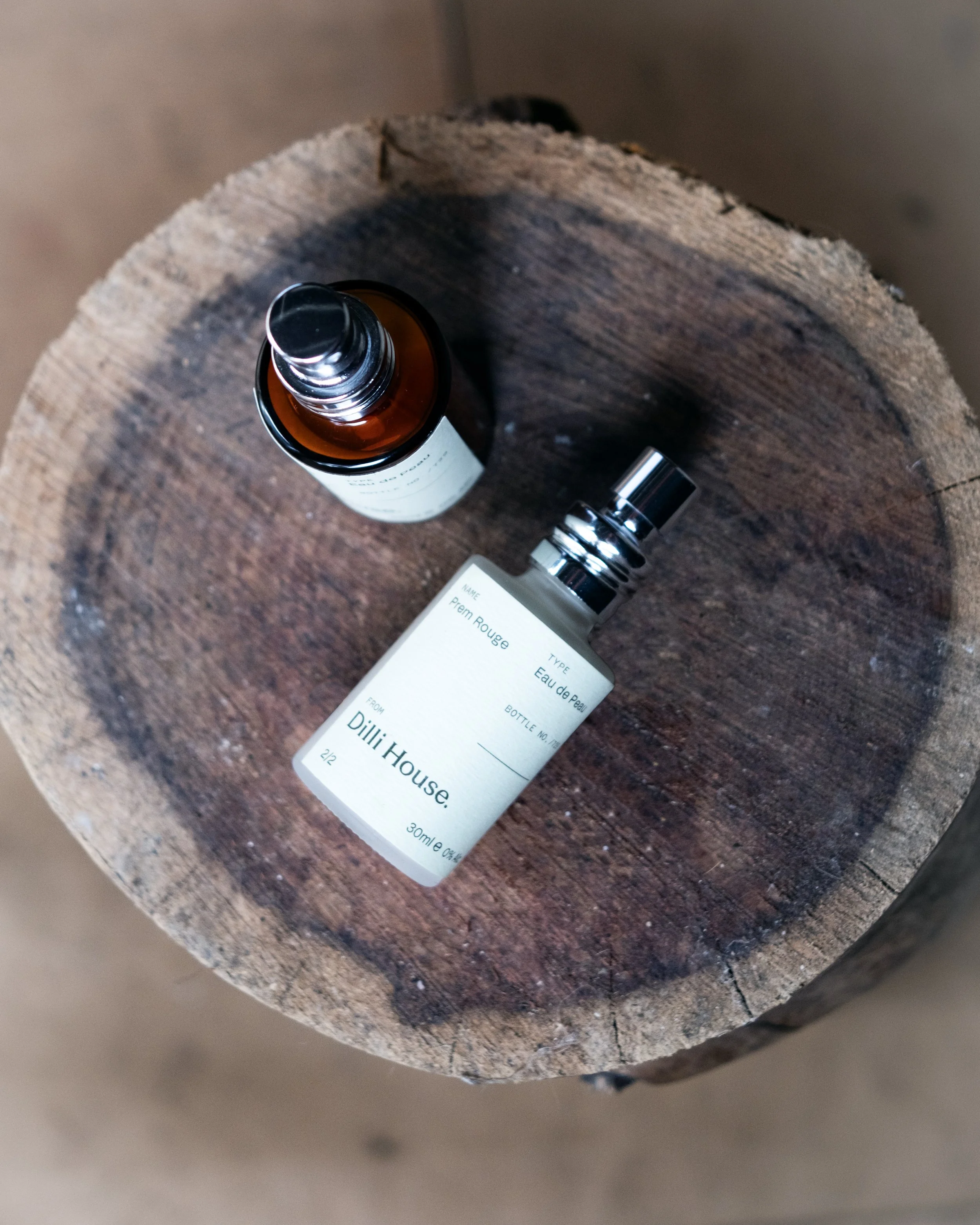
Our fragrance, Prem Rouge, is 100% natural and alcohol-free. We use a water-based formula that carries pure plant oils without ethanol. We chose this approach because it aligns with what we value: simplicity, transparency, and a gentler relationship between product and person.
We do not claim natural perfume is better than synthetic. We believe it is a meaningful alternative for people who care about what goes on their skin and where it comes from. If that resonates with you, we think you will appreciate what we have made.
Why choose natural?
A natural perfume uses aromatic materials derived from plants: essential oils, absolutes, CO2 extracts, tinctures, and resins. These are sourced from flowers, bark, leaves, roots, and seeds. The raw materials are extracted through distillation, cold pressing, or solvent extraction.
The important distinction is that no synthetic aroma chemicals are used. In a fully natural perfume, every scent molecule comes from a botanical source. This is a stricter standard than terms like “clean” or “made with natural ingredients,” which can still contain synthetic components.
If you’d like more pieces like this, we share them quietly — subscribe to the journal.